Click to enlarge
Puggéra - 1 |
Quick Facts |
|
| Number of members in the okka: | Around 150, none of whom resides in the ainmane; 14 (three families) live near it. | |
| Location – village: | Dēvaṇagēri. | |
| Age: | Rebuilt in 1942. | |
| Community: | Kodava. |
| Date visited: | 31 December 2003. |
| Location – village: | Dēvaṇagēri. |
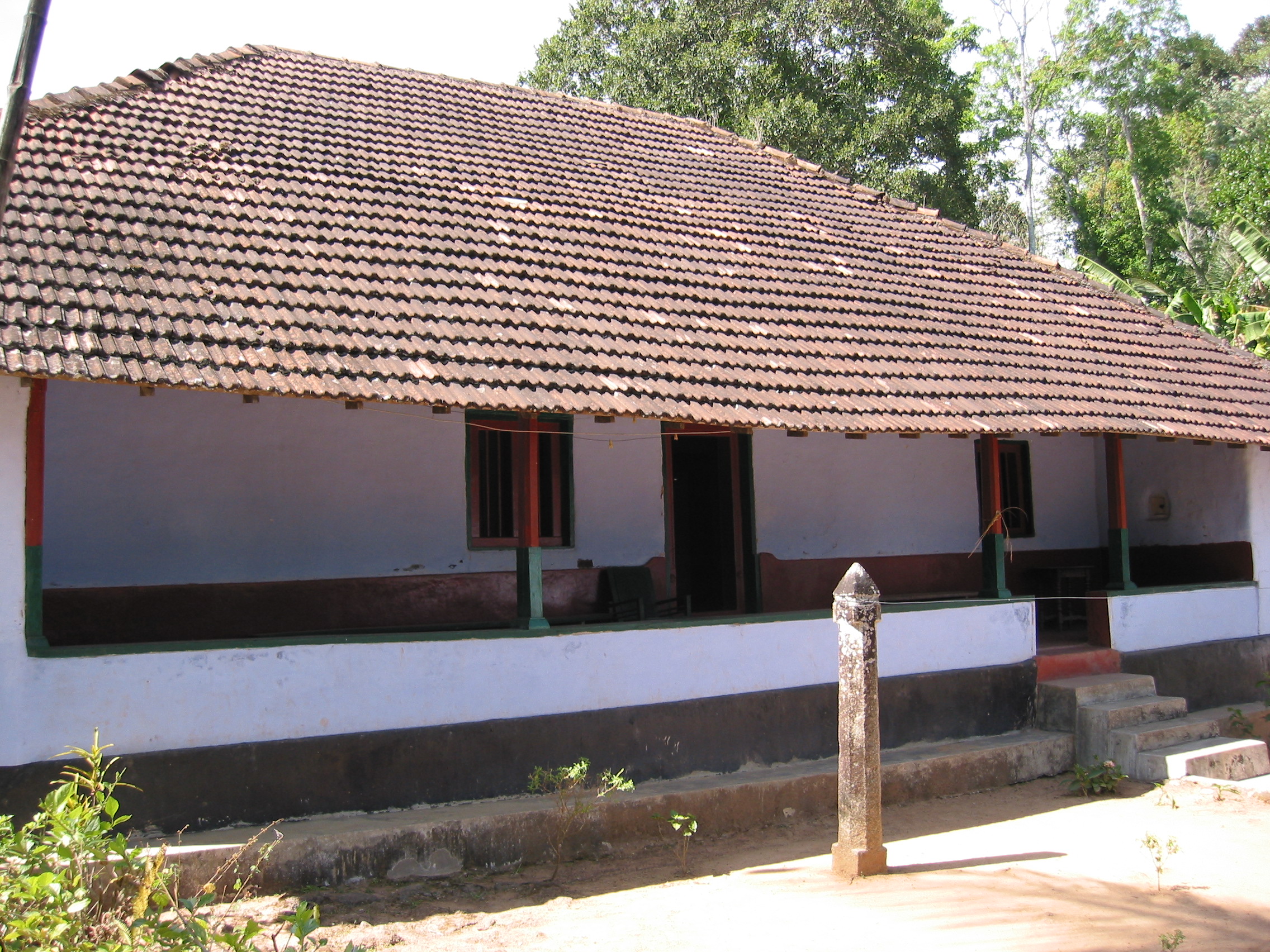
| Type of ainmane: | Othe pore. There is a hanging lamp and a small photo of Baithurappa in the nellakki. |
| Direction facing: | East. |
| Kall boti: | Yes, in the front yard, very close to the house, because when the ainmane was rebuilt, it was extended in the front. |
| Age: | Rebuilt in 1942. |
| Original ainmane? | This is the third ainmane. The first one was a mund mane, which was later broken up and split along the mund into two houses, the one in front being the ainmane of the bhaga of Subbayya, the son of the karanava by his first wife. That ainmane got burnt in 1939 and was rebuilt in 1942 to be larger than the previous one, extending it by 20 feet into the yard in front. The other two bhagas do not have ainmanes. |
| Woodwork: | Hardly any, very simple. |
| Electricity in the ainmane: | No. |
| Telephone in the ainmane: | No. |
| Kanni kamba: | The first pillar to the left of the steps to the verandah. |
| Kanni kombare: | Room in the south-west corner of the house where meedi is kept. |
| Floor: | Only the hall and verandah were cemented a long time ago. All the other rooms have cowdung-washed mud floors. |
| Roof: | Tiled when rebuilt in 1942. |
| Number of rooms: | Six (including the kitchen). |
| Attic: | Empty hall where nothing is stored. There is no staircase to the attic. When necessary they use a ladder. |
| Kaimada: | Nearby, in front of the house. |
| Al rupa: | Whether to observe the al rupa custom or not is left to each family. If they wish, a silver one is taken to the Bhagavathi temple to be sanctified with a puje before immersing it in the Kaveri Sangama. Death rituals are generally not observed in the ainmane. Only the family that lives near it and lights the sacred lamp in the nellakki observes death rituals in the ainmane.The others perform the ceremonies related to death in their individual houses. |
| Temples/shrines nearby: | Kokatt Choundi shrine. Thalakatkeri Bhagavathi temple. |
| Festivals celebrated in the ainmane: | They do not celebrate Karanang kodpa during Pathalodi. On the day when the annual General Body meeting is held, all the three bhagas get together, their thamane mudiya are invited, and vegetarian meedi is offered to Karanava Monnayya (since he was a vegetarian – see story). On the same day they offer pig as barani to Kokaat Choundi. Kail Polud, Kaveri Sankramana and Puthari are celebrated in the ainmane only by this bhaga. The other two bhagas do not join in any of these festivals except for the Choundi there that is held once in four years. |
| Number of members in the okka: | Around 150, none of whom resides in the ainmane; 14 (three families) live near it. |
| Book on the okka and Family tree: | They have two books on the okka: The Silver Jubilee souvenir of the Baithurappa Sangha (name given to their General Body) of the okka (1985), and Puggera Okkada Purva Kathe by P.J.Chinnappa (2003). (They gave us copies of both) The family tree (for five generations starting with the first ancestor, adi purusha Monnayya who established the okka) is given in the book.The current generation we were told is the seventh one. |
| Name of Karanava: | Monnayya (posthumous son of adi purusha Monnayya who established the okka), a famous and popular karyakara of king Viraraja. |
| Name of Aruva okka: | Ichanda at Thalakatkeri. |
| Thakkame rights of the okka: | Ur thakka for Thalakatkeri (a keri of Devanageri). Deva thakka of the Baithurappa temple in Malabar. Korathajja from Baithur comes here with the thiru ayudha (sacred sword)to announce the annual Baithurappa temple festival in January and spends the night here. They take rice loaded on oxen for the temple festival. |
| Pattedara: | P.K. Subbayya (about 90 years old), for this bhaga. |
| President of the okka: | P.K. Subbayya (since he is the eldest member in the three bhagas). Since 1960, the common General Body of the three bhagas of the okka is called ‘Baithurappa Sangha’.They have a General fund, an Education fund and a Death fund. |
| Mand nearby: | In front of the Puggera ambala, where there is a chithal tree with a mad around it. |
| Ambala nearby: | Puggera ambala (also called the Thalakatkeri urambala), located at the entrance to the ainmane, near the chithal tree and tank. It is a long building with a room to the right and an open verandah with aimara and pillars to the left. |
| Deva kaad nearby: | Aiyappa Devada kaad (22 acres). Angarappa kaad (1½ acres). Botekara Ayyappa kaad in the middle of the Mukkatira estate (a few cents). |
| Thutengala of the okka: | Some distance away, in front of the ainmane. |
| Year when last wedding held in the ainmane: | 1952. |
| There/Kola in the ainmane: | Chamundi there once in four years, when all the three bhagas of the okka get together. (In the years when they have no there the three bhagas togetheroffer barani to Chamundi.) |
| Folksongs sung in the ainmane: | Not any more. They used to sing karana pat during Puthari. |
| Singers of folk songs in the okka: | There are many in the okka who sing and dance. |
| Paintings/drawings on walls: | Have not heard of it. |
| Kadanga nearby: | Many, all over the estate. |
| Stories related to okka name: | In the early 1600s king Viraraja asked his Parpathigar to go to every village and meet every land-owner and give his okka a name to identify it for tax collection and for keeping records. In Devanageri he was told about their adi purusha who was called ‘Pugge sthana Monnayya’ because the area was known as Pugge sthana. So he called his okka ’Puggera’. Pugge apparently denotes an abundance of sweet fruit which was available in the forest nearby. |
| Stories related to the okka: | [Source: Puggera Okkada Purva Kathe by P.J.Chinnappa (2003), and Puggera mane paat] In the late 1500s, Ponnayya was a Paleyagara of five villages in this area of Kodagu. His elder son Monnayya, who established the Puggera okka and was called the adi purusha of the okka, acquired a lot of land in the area called ‘Pugge’ and became prosperous. He built a mund mane for the okka. A group of marauders from Karepalli in Hunsur taluk attacked the ainmane, destroyed it, killed all the people there and looted the gold and money in the house. At that time, Monnayya’s wife Kalavva (from the Somayyanda okka) was expecting a baby. She managed to escape to the Ichanda house and with their help she went to her parent’s home. read more >>
In the Puggera mane paat, Monnayya’s wife wrapped and hid her little baby in her sari and escaped to her Chomeyanda Mava’s place.
Her son was named Monnayya after his father. When he grew to be an adult he returned to the ainmane, rebuilt it and started cultivating the land that lay fallow. He became prosperous and famous as the karyakara of the Kodagu Raja. He is the karanava of the okka.
Andamada Chetticha from Kiggattnad, who had heard of Monnayya’s wealth, came with his men by stealth one night, and used Monnayya’s oxen to plough Monnayya’s paddy fields, claiming Monnayya’s land as his own. When Monnayya confronted him the next morning Chetticha threatened to attack him in 30 days and challenged him to fight for the land. In the Puggera mane paat, Monnayya took the dispute with Chetticha regarding the land to the ur, nad and finally to the desha thakkas. But to no avail. Then Banna Karimbu who worked for him asked him to seek god Baithurappa’s help. Monnayya, who was a devotee of god Baithurappa in Kerala went to the Baithurappa shrine in Malabar and prayed for help. He was assured of his help and Baithurappa sent goddess Kokatt Chamundi with him to protect him. Monnayya became a strict vegetarian and meditated on Baithurappa in the kanni kombare, keeping all his weapons ready in the hall. On the 30th day, while Monnayya was deep in meditation Chetticha’s army arrived to attack him.They were badly bitten by bees and hornets and shot at and attacked by the weapons that acted miraculously on their own. At the same time, Chamundi took the form of a fierce tiger and attacked Chetticha who retreated with his army. Monnayya woke up from his meditative trance and saw all that happened. He sang the praises of Baithurappa and gave a sthana to Chamundi at some distance in front of his house and offered her barani.
Following this event, when he went to the Baithurappa temple he was appointed as the thakka of the temple and asked to conduct the annual festival there. His okka was appointed as the battyath okka of the temple and they took rice loaded on 12 oxen to the temple festival every year. Monnayya bought 300 bhattis of wetland near the temple and gifted it to the temple for its use during the festival, in case circumstances prevented the rice from the okka reaching the temple in time. From the time of Monnayya’s sons, as instructed by Monnayya, the okka has been taking rice loaded on three oxen for the temple festival every year.
As instructed by Baithurappa, Monnayya personally informed all the shrines and well-known okkas in Edenad, Beppunad and part of Kiggatnad (he stopped at Arvathoklu because he took ill) that they should take rice loaded on oxen to Baithurappa’s temple in Malabar for the annual temple feast there.
When Chetticha and his men who were badly wounded in the attack fled from the Puggera ainmane they passed through the fields of the Ajjinikkanda okka in Chembebeliyuur. At that time, Ajjinikkanda Mandanna who was related to Puggera Monnayya, was working in the fields with his men. When he saw the enemies of Monnayya he and his men attacked and killed them.
Monnayya’s fame in defeating Chetticha and his men reached king Viraraja and he appointed him as his karyakara. His fame as a truthful, disciplined and efficient official made him popular with the king and the people. Learning of the greatness of Baithurappa from him, Viraraja also became a devotee of Baithurappa and sent annual kayiche (offerings of rice, coconuts, jaggery etc.,) to the temple. The king also got a pouli (building for pilgrims) built in front of the Baithurappa temple, with Monnayya overseeing the construction.
After getting the pouli constructed, Monnayya thought of constructing one at his own expense to the north of the temple, and got the king’s men to start work on it. The king’s spies conveyed this news to the king, who was enraged that Monnayya had not sought his permission for this. Fearing that Monnayya was becoming too independent and powerful he declared him a traitor and sentenced him to death. Monnayya who was at Baithur at the time was killed by the king’s soldiers in the presence of god Baithurappa.
The first adi purusha Monnayya had amassed 1550 bhattis of wetland as well as pasture and forest attached to it. He gave 200 bhattis to his friend Ichanda Somayya who established his okka and built his ainmane in Thalakatkeri,near that of the Puggera okka. After karanava Monnayya’s death, the remaining land was divided equally between his three sons - Subbayya (his second son by his first wife, Somayyanda Kalavva, who the nad decided was his rightful heir, although he was the second son) and Karicha and Somayya (his sons by his second wife, Kalamanda Ponnavva). Each son got 450 bhattis each along with the attached pasture and forest lands. During the times of the Haleri kings, the king’s spies would scour the villages to find young men whom the soldiers would forcibly take to be trained as soldiers for the king’s army. In the Puggera okka they dug deep pits called ‘nekkuli’ where they hid the boys of the okka when they heard of the movements of the spies in their area. The pits were about 12 feet deep and quite wide, with ladders used to climb in and out. In the wall of the pit was carved a room (like a cave) for the boys to eat and sleep in. The remains of two such pits can be seen in the high area near the ainmane. |
Chinshai Technologies | Ainmanes Copyright 2011. All right reserved